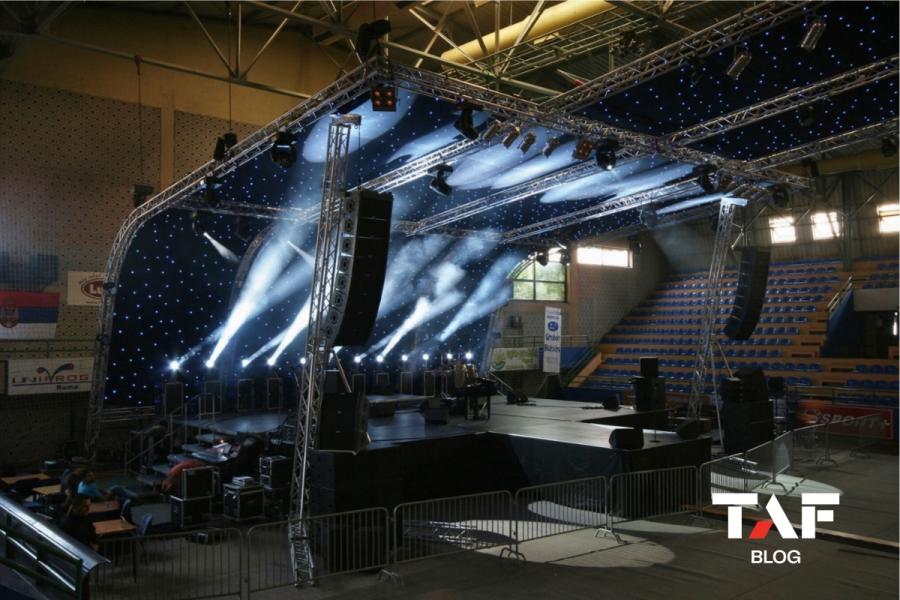
Aluminum trusses are the backbone of modern event production and temporary structures. Concert stages, sports events, TV sets, extreme sports arenas, festivals, and trade shows all rely on truss systems to carry lighting, sound, LED walls, scenic elements, and sometimes complete roof structures. These builds are fast, repeatable, and often customized show-by-show — which means the structural “inputs” change constantly: spans, rigging points, equipment weight, cable runs, and outdoor conditions.
That is why loading tables (also called loading charts) matter. They are the technical bridge between “what we want to hang” and “what the structure can safely carry.” Read correctly, they enable safe, efficient designs and smoother approvals. Misread, they can lead to overload, excessive deflection, and serious risks.
This article explains what loading tables are, why they are critical, how to read them, where the numbers come from, how they are validated (including TÜV testing and certification practices), and why two manufacturers can publish different load ratings for trusses that appear similar.
What is a loading table?
A loading table is an engineering reference that defines maximum allowable loads for a specific truss model under specific conditions. The keyword is “specific.” Loading capacity of aluminum truss depends on many aspects working at the same time for each truss application. The basic but crucial criteria of safe installations have to take into account how the truss is supported, the span length between supports or hanging points, how the trusses are loaded, i.e. uniformly distributed load (UDL) vs point load, the position of the load (near supports or in the middle of the span) and what the deflection limits of installed aluminum trusses are.
Most truss loading tables or loading charts cover some of the above mentioned aspects such as:
- Simply supported span (supported at two ends)
- Suspended span (hung from points, often with chain hoists)
- UDL (uniformly distributed load)
- Point load at a defined position (often midspan)
- Deflection limits
A good chart also includes the product identity. Its code name and series, main tube/chord size, thickness of the tube wall and specifications of the braces. Furthermore, with some of the manufacturers you can also find data sheets of their products that apart from the loading tables include connection type, diagrams of the load case, safety factors, and any limitations of the specific truss system. In short, loading tables describe a set of safety limits of the truss system which your real installation must follow.
Why is it important?
Loading charts protect people, equipment, schedules, and approvals.
Safety above the public
Trusses routinely carry heavy loads above crew and audiences. A wrong assumption about span, support, or load placement can create excessive bending and instability. Loading tables define boundaries that keep the system in a predictable, engineered range.
Compliance and approvals
Venues, authorities, and insurers increasingly expect documented load calculations for temporary structures. Manufacturer load data — especially when independently verified — is often required for permitting and sign-off.
Efficient design
Without trusted load charts, teams either under-spec (unsafe) or over-spec (unnecessary weight, transport cost, longer build times). Correct charts help select the right truss series and support method, keeping structures safe and cost-effective.
Better change control
Event installations change. Adding fixtures, swapping a screen, or moving a pick point should trigger a quick check against the chart. Having clear load data makes that check practical under real production timelines.
How to read loading charts correctly
Most mistakes happen when someone reads a load value but ignores the conditions. Use this approach.
Step 1: Confirm the exact truss model
A “400 mm box truss” is not one product. Chord diameter, wall thickness, bracing, and connection design change capacity. Start by matching the chart to the exact series/specification of the product that you use.
Step 2: Match the support configuration
Check whether the chart assumes two-end support (simple beam), suspended hanging points, multiple supports, or cantilever/overhang. If your build doesn’t match the diagram, the numbers don’t apply directly. In these cases it is necessary to contact a structural engineer for your design approval or contact the manufacturer.
Step 3: Use the correct span definition
Span is typically measured between support centres (or between hanging points). Confirm the chart’s definition and measure your real structure accordingly.
Step 4: Identify the load case
UDL and point-load values are not interchangeable. A truss usually carries more when the load is distributed than when it is concentrated.
Step 5: Check point-load position
Many charts assume a point load at midspan (often the worst case of load placement). If your load is elsewhere, use the correct case or get an engineer’s calculation.
Step 6: Respect deflection limits
Even if strength is adequate, excessive deflection can be unacceptable for TV, precision lighting, or LED walls. If the chart provides a deflection-governed limit, obey the lower value.

Step 7: Add the real-world extras
Include clamps, adapters, motors, chain angles, cable weight, power supplies, and safety bonds. For outdoor builds, wind and dynamic effects require engineering review beyond a simple loading chart.
How to turn a loading chart into a safe rig plan? Workflow plan
Let’s walk through a realistic workflow. Imagine you are building a truss span to carry lighting and a small LED element for a sports event. You select a specific 4-point box truss series and you plan a suspended span between two chain hoists.
1) Choose the correct chart
You open the manufacturer documentation and find the chart specifically for “suspended span – two hanging points.”
2) Confirm span length
Your hang points will be 12.0 m apart measured center-to-center. In the chart, you locate the row/column for 12 m (or the nearest conservative longer span if exact 12.0 isn’t provided).
3) Decide whether your load is UDL or point load
If you have fixtures spaced evenly along the span, your primary case is UDL. If you have one piece of equipment (e.g. a compact LED panel, motor or a light), it is a case of point load application. In practice, many real rigs are a combination: a base UDL plus one or more point loads.
4) Add up the equipment weight
You calculate the total hanging mass:
- fixtures and brackets
- clamps, couplers, half couplers
- safety bonds and hardware
- cable looms and power distribution boxes
- any hoist, trolley, or pick hardware that is carried by the span
The goal is to avoid the classic undercounting mistake: “the fixture is 20 kg, so it’s 20 kg.” In reality, the fixture plus hardware is often significantly more.
5) Check chart limits and deflection
You compare your calculated load to the chart limit. If the chart provides both a strength limit and a deflection-based limit, you respect the lower value. For TV or camera-facing installations, deflection can be as important as strength: a span that visibly sags is a production problem even if it is technically strong enough.
6) Validate load positions
If you have a point load, you check whether the chart assumes midspan. If your point load is near midspan, the midspan case is appropriate. If it is closer to a hanging point, you still must use the correct documented case — or have an engineer verify the structure for your exact load locations.
This workflow looks simple, but it prevents most real-world mistakes: wrong chart, wrong span, wrong load type, or incomplete weight accounting.
Where do loading charts come from?
Published load ratings come from engineering analysis plus defined assumptions. Manufacturers model truss behavior using structural calculations and often finite element analysis (FEA) to evaluate internal forces (bending/shear/axial), stress levels in chords and nodes, stability/buckling behavior, and deflection under service loads.
The model is only as good as the input:
- Material specification (alloy/temper, certificates, consistency)
- Tube dimensions (diameter, wall thickness, tolerances)
- Node and weld design (geometry, heat-affected zones, repeatability)
- Connection system (how loads transfer through spigots/bolts)
Where do loading charts come from?
Published load ratings come from engineering analysis plus defined assumptions. Manufacturers model truss behavior using structural calculations and often finite element analysis (FEA) to evaluate internal forces (bending/shear/axial), stress levels in chords and nodes, stability/buckling behavior, and deflection under service loads.
The model is only as good as the input:
- Material specification (alloy/temper, certificates, consistency)
- Tube dimensions (diameter, wall thickness, tolerances)
- Node and weld design (geometry, heat-affected zones, repeatability)
- Connection system (how loads transfer through spigots/bolts)
Reputable documentation explains the load cases, assumptions, and safety margins applied. This is why a well-prepared loading table is as much about clarity and traceability as it is about the number itself.
Safety: turning load data into safe builds
Loading charts work best when they are part of a broader safety routine.
Best practices in the field
- Treat every added item as weight: hardware and “small accessories” add up
- Keep load paths clean: avoid side pulls, twisted spans, and eccentric connections
- Install correctly: fully seat spigots, use correct pins/bolts, and follow orientation rules
- Inspect before every build: look for damage, cracks, deformation, and worn connectors
- Document changes: if the rig changes, re-check the chart and overall design
Indoor vs outdoor
Indoor structures often focus on vertical load and deflection. Outdoor roofs add wind, which creates horizontal forces, uplift, and dynamic movement. For public events and outdoor roofs, manufacturer charts are a starting point — a qualified structural engineer must evaluate the full system (roof, towers, ballast/anchors, wind exposure, and load combinations).
How are loading charts tested and proven correct?
The strongest charts are backed by verification and testing, not only theory but in practice as well.
A responsible process typically includes engineering design and modeling, prototype production using specified material and welding procedures, physical load tests to validate stiffness, deflection, and joint performance and production quality controls so every manufactured truss matches the tested design.
What physical testing checks
- controlled static loads (UDL and/or point loads) with measured deflection
- proof testing to confirm elastic behavior and margin
- connector/joint behavior under load (slip, local deformation, repeatability)
Why TÜV matters
TÜV is widely recognized as an independent technical inspection body. TÜV-backed assessment supports confidence that documentation and test results have been reviewed and that the published load data is defensible for professional projects and approvals. For many international jobs, third-party verification helps venues, authorities, and insurers accept load documentation faster.
Why can "identical" product have different load charts across manufacturers?
Two trusses can look similar and still perform differently. Load charts can differ because of several things, here are some of them:
Materials and dimensions
- different alloys or material certification discipline
- different wall thickness or tighter/looser tolerances
Joints and connections
- node geometry and weld quality control (often decisive)
- connection stiffness and how loads transfer through spigots/bolts
- allowances for wear, assembly cycles, and connector slip
Engineering assumptions and safety margins
- different loading case definitions (where loads are applied, how supports are designed)
- different safety factors and deflection criteria (serviceability vs strength)
- different verification scope (internal calculation vs independent testing/certification)
Overall, it is important to keep all of the above in mind in order not to compare only the headline number as it might be a bit deceiving at the first sight. Always compare the assumptions, safety factors, and the credibility of the documentation behind the number.
Common pitfalls (and how to avoid them)
Even experienced teams repeat a few classic mistakes:
- Using the wrong table: “supported” vs “suspended” charts are not interchangeable.
- Ignoring span definition: overall truss length is not always the engineering span.
- Forgetting accessories: clamps, cable, and distribution hardware can add meaningful weight.
- Assuming symmetry: one heavy cluster can dominate the whole span even if total weight looks acceptable.
- Neglecting deflection: if a camera sees it, serviceability matters; choose a stiffer series or reduce span/load.
- Treating outdoor loads as ‘just more weight’: wind is directional, dynamic, and must be engineered as a load combination.
A strong habit is to treat the loading chart as a checklist, not a single number.
Glossary: the terms you see in load documentation
UDL (Uniformly Distributed Load): load spread along the span
Point load: concentrated load at a defined single position
Span: distance between supports/hanging points (as defined in the chart)
Deflection: how much the truss bends under load; often limited by serviceability criteria
Safety factor: margin between working limits and theoretical failure thresholds
Load case: a defined scenario of supports and loads used for calculation/testing
Serviceability: performance under normal use (stiffness/deflection) rather than ultimate strength
Conclusion
Loading tables and loading charts are the language of safe truss engineering. They turn a truss system into a predictable, documented structural tool — enabling efficient designs, safer builds, and smoother approvals.
For event and temporary structure professionals, the best approach is simple: match the correct chart to the correct real-world configuration, count every kilogram, respect both strength and deflection limits, and involve structural engineering whenever wind, roofs, large point loads, or public-critical exposure are part of the job.
TAF supports professional projects with clear documentation and a verification mindset that helps customers build with confidence.